Hotel Indian River, 1888-1968: the eighty-year run of Rockledge's grandest hotel
The Hotel Indian River opened on the Rockledge bluff in 1888, drew Northern wealth all winter, survived the 1894-95 freeze and the Depression, and stood until 1968 when it was demolished for a bank parking lot.
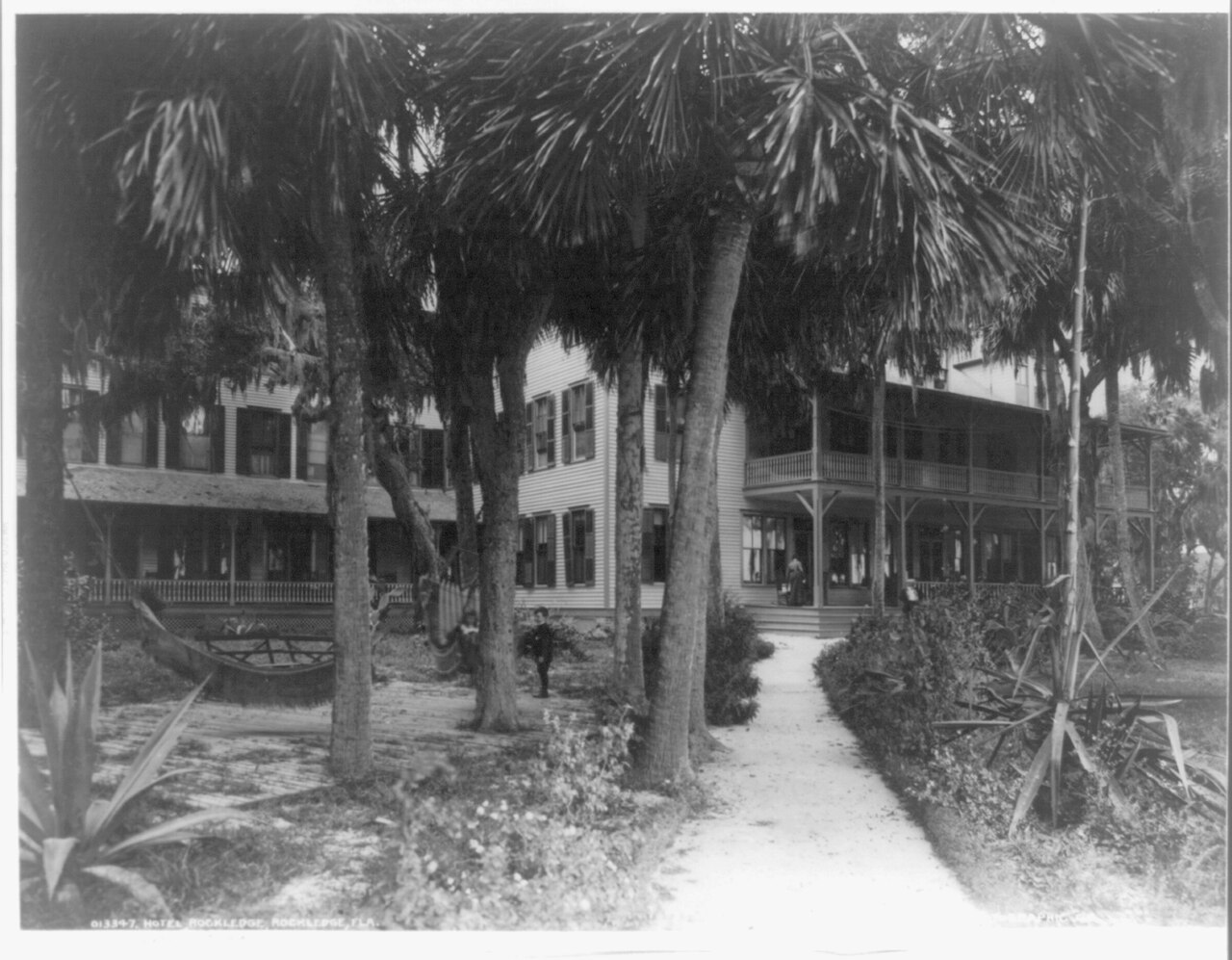
The Hotel Indian River opened on the Rockledge bluff in January 1888 with 100 rooms, electric lighting (powered by its own generator, the first in Brevard County), a riverfront pier for steamboats, and rates of $4 per day American plan. It was the largest hotel between Jacksonville and the Florida Keys when it opened. It closed in 1959, sat vacant for nine years, and was demolished in 1968 for a bank branch and a parking lot. Today the corner of Riverside Drive and Barton Avenue, where the hotel stood, has a small marker noting what was there.
The 1888 opening
The hotel was built by a consortium of Rockledge property owners and Northern investors who’d noticed the steamboat traffic and decided the Indian River needed a destination hotel, not just a stopover. Construction began in 1887, the same year Rockledge incorporated. The architect, whose name appears in the Brevard County permit records as O. P. Hatfield of Jacksonville, designed a four-story frame structure with two long wings flanking a central rotunda. The footprint covered roughly an acre.
The hotel’s first manager was H. P. Shares, who’d come down from a White Mountains resort in New Hampshire. The Florida winter season ran from mid-December to mid-April. Rates of $4 per day included three meals; long-stay rates ran $20 to $25 per week. By comparison, Henry Flagler’s Hotel Ponce de Leon in St. Augustine, opening the same season, charged $25 per day. The Indian River was the more affordable option for the comfortable-but-not-wealthy Northerner: clergy, lawyers, small-business owners from Cleveland, Buffalo, Boston, Hartford.
Steamboat to railroad
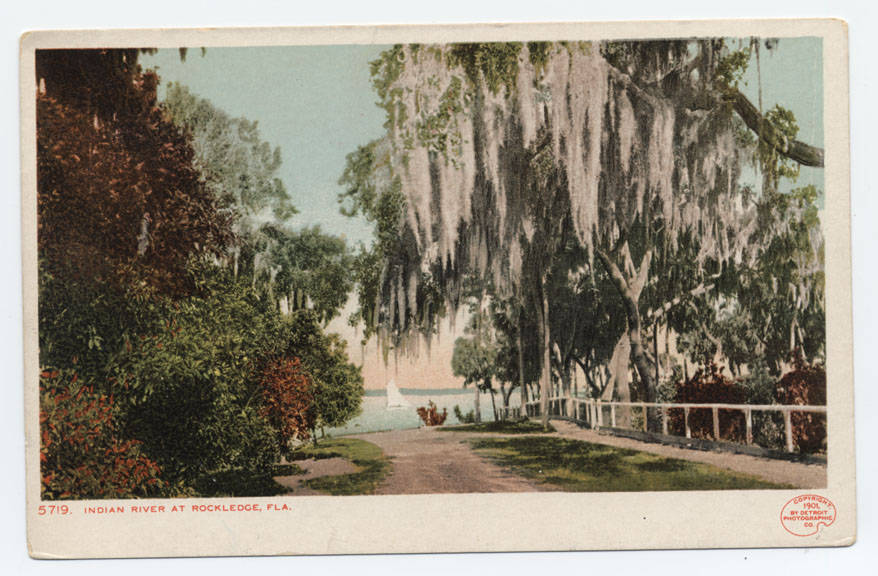
Until 1893, the only way to reach the Hotel Indian River was by steamboat from Titusville. The Jacksonville-St. Augustine-Indian River Railway ended at Titusville; from there, the St. Lucie or the Rockledge or the Sweeney ran south to Rockledge, dropping passengers at the hotel’s own pier. The crossing took about three hours from Titusville. Some guests came down from New York by steamer to Jacksonville, train to Titusville, riverboat to Rockledge: three or four days total.
The Florida East Coast Railway, then known as the Jacksonville, St. Augustine & Indian River Railway, reached Rockledge in 1893 under Henry Flagler’s expansion. The first FEC train arrived on July 25, 1893. The hotel could now be reached by direct train from the Northeast, with no steamboat transfer. Passenger volume jumped. So did rates, modestly, since the supply of comparable Florida coastal hotels also jumped over the same years.
The 1894-95 freeze and its aftermath
The hotel survived two consecutive killing freezes in December 1894 and February 1895 that wiped out most of the citrus on the Indian River. Rockledge’s reputation as a winter destination took a hit because the surrounding citrus groves, which were part of the visitor appeal, were ruined. The hotel pivoted its marketing to climate and river views rather than orange groves and shipped fruit. Occupancy stayed steady but the long-stay-by-the-month clientele declined as some converted to renting houses on the cheaper post-freeze land instead.
The Henry Flagler comparison
Flagler’s hotels (the Ponce de Leon, the Alcazar, the Royal Poinciana in Palm Beach, the Breakers, the Royal Palm in Miami) dwarfed the Hotel Indian River in scale, opulence, and advertised glamour. The Royal Poinciana, opening in 1894, had 1,150 rooms to the Indian River’s 100. Flagler kept his hotel rates above $25 per day and built a clientele of the very wealthy. The Indian River served a step below.
This wasn’t a disadvantage in the long run. The Indian River’s lower price point made it less exposed to the 1929 stock market crash than the Flagler properties. The Ponce de Leon stopped operating as a hotel in 1967 and is now a college. The Royal Poinciana was demolished in 1935. The Royal Palm in Miami burned in 1925 and was never rebuilt. The Indian River outlasted all three.
The decline
Mid-century brought air conditioning to coastal Florida. Once homes and motels could be air-conditioned cheaply, the Gilded Age model of a winter-only hotel with no AC ceased to make sense. The Hotel Indian River operated through the 1940s and 1950s with diminishing seasons. By the late 1950s it ran with fewer than half its rooms open, mostly serving long-term elderly residents who’d stayed on year-round.
The hotel closed for the last time in 1959. Various reuse proposals appeared in the early 1960s: a retirement home, a conference center, a museum. None went forward. The building deteriorated. By 1965 the roof leaked, the ground floor was vandalized, and the local fire department had it flagged as a hazard.
The 1968 demolition
In May 1968 the hotel was sold to Atlantic National Bank (later absorbed into Barnett Bank, then Bank of America). The bank announced plans for a new branch and parking lot on the site. Local preservationists, including a small but vocal group of Rockledge Drive residents and members of the Brevard County Historical Society, opposed the demolition. They had no zoning lever. The site wasn’t on the National Register (the Rockledge Drive Historic District wouldn’t be listed until 1990). The bank had a permit.
Demolition began in late August 1968 and finished in October. The hotel was torn down by hand and bulldozer. Some of the millwork, fireplaces, and stained-glass windows were salvaged and ended up in private homes in the area; a few pieces are at the Brevard Museum of History and Natural Science in Cocoa. The Florida Memory Project holds a photographic file of the demolition.
Florida Today, then a five-year-old newspaper headquartered in Cocoa, ran a front-page story on October 12, 1968 with the headline “Last of an Era: Hotel Indian River Comes Down.” The article noted that the hotel had hosted Thomas Edison, William Howard Taft (as Secretary of War before his presidency), Grover Cleveland (after his presidency), and at various times members of the Rockefeller, Vanderbilt, and Du Pont families. The verification of those guest claims relies on hotel registers, most of which were lost or destroyed in the demolition.
What’s there now
A Bank of America branch and its parking lot occupy the site. A small historical marker, installed by the Rockledge Historical Commission in 1995, identifies the corner as the former hotel location. The marker has the hotel’s opening and closing dates, a brief description, and a photograph etched into a bronze plate. It’s at Riverside Drive and Barton Avenue, on the river side of the street.
Twenty paces north of the marker, the coquina bluff still drops toward the Indian River the way it did in 1888. The hotel’s pier is gone, but the slip into the river where the steamboats docked is still recognizable as a notch in the bluff. The view east across the river to Merritt Island is unchanged.
What we lost
The Hotel Indian River was the most architecturally significant Gilded Age building in Brevard County. Its demolition in 1968 came eight years after the demolition of New York’s Pennsylvania Station, the event that’s often credited with launching the modern American historic-preservation movement. The Rockledge case is one of dozens of Florida hotels lost in the same window, before the National Register was an effective tool. The Royal Poinciana, the Royal Palm, the Tampa Bay Hotel’s contemporaries, the Belleview Biltmore, most of them came down between 1925 and 1985. The few that survived, like the Tampa Bay Hotel (now part of the University of Tampa), are exceptional.
The Rockledge Drive Historic District, listed in 1990, came too late for the hotel. It does protect the surviving residential streetscape that the hotel anchored, including several houses built in the same architectural vocabulary by the same construction crews.
Sources
- Florida Memory Project, “Hotel Indian River” photographic file, floridamemory.com
- Florida Today archive, 1968 demolition coverage (microfilmed at the Brevard County Library, Cocoa branch)
- Library of Congress, Detroit Publishing Company Collection, postcards of Hotel Indian River and Hotel Rockledge, ca. 1900-1910, loc.gov/pictures/collection/det/
- Brevard County Historical Society, oral history interviews collected 1985-1995 (transcripts at the BCHS archive, Cocoa)
- Florida East Coast Railway timetables, 1893-1920 (digitized at the Florida State Library)
- Brevard Sun and Cocoa Tribune, Rockledge social columns 1900-1959
Further Reading
As an Amazon Associate we earn from qualifying purchases.