The Indian River steamboat era at Rockledge, 1877-1893
Before the FEC Railway, Rockledge was reached by side-wheel steamer from Titusville. The Rockledge, the St. Lucie, the St. Sebastian, the Sweeney: how the Indian River steamboat fleet built the town's first tourist economy.
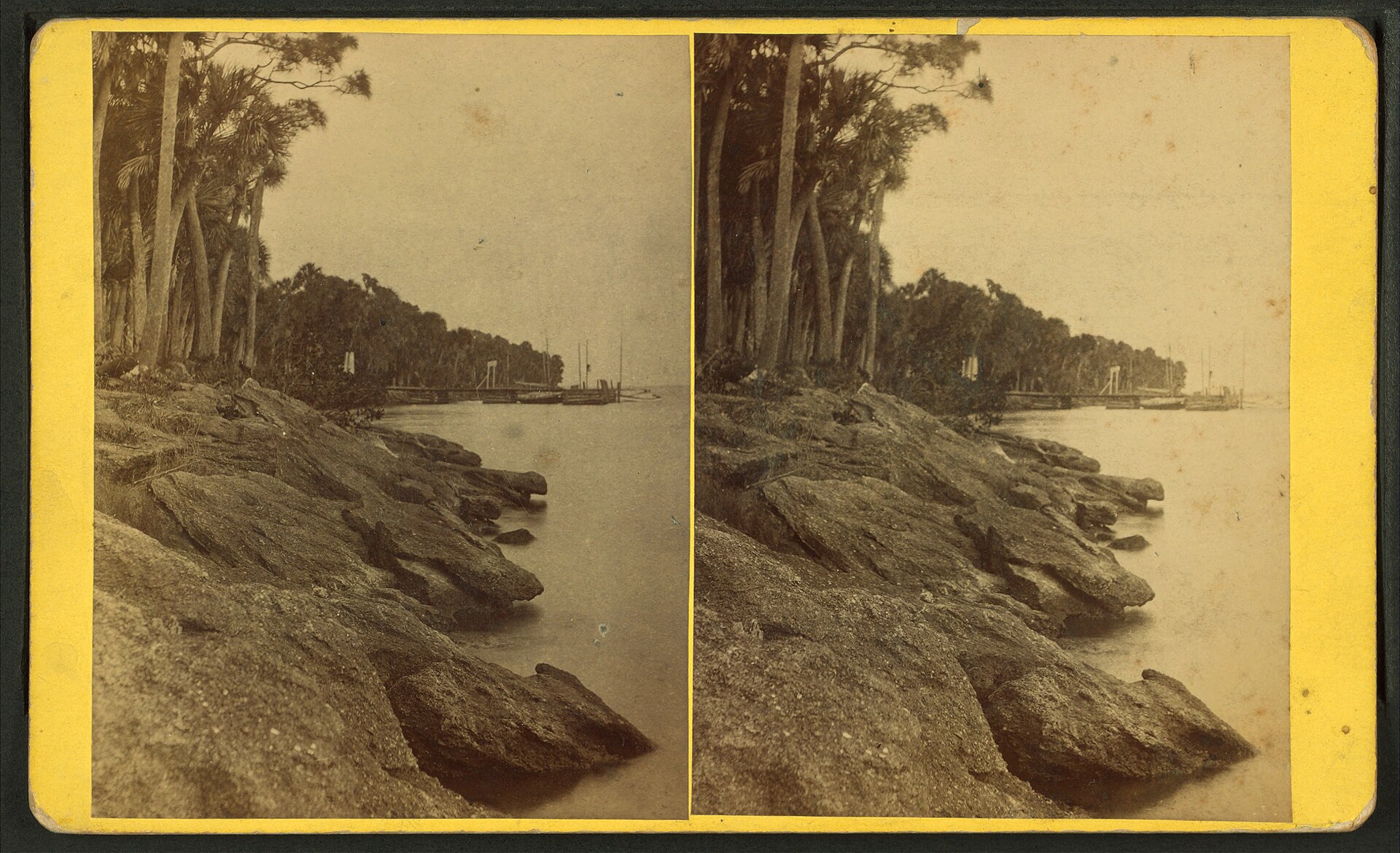
From 1877 to 1893, Rockledge was a stop on the Indian River steamboat line. The trip from Titusville took roughly three hours, ran twice daily during the winter season, and connected Rockledge to the Jacksonville-St. Augustine-Indian River Railway at Titusville, which connected to Northern rail at Jacksonville. The boats had names: the Rockledge, the St. Lucie, the St. Sebastian, the Sweeney, the Indian River. They were side-wheel and stern-wheel shallow-draft steamers, 100 to 130 feet long, drawing two to four feet of water.
Why steamboats and not road
The Indian River runs roughly 120 miles north-to-south along the Atlantic coast of Florida, separated from the open ocean by the barrier islands. In the 1880s there were no bridges across the lagoon. The mainland west of the lagoon had a single rough road, the Old Dixie Highway corridor, but it crossed swamps and was barely passable south of Titusville. Boats were faster, more reliable, and could carry both passengers and freight (citrus, in particular) economically.
The fleet
Edward A. Mueller’s Steamboats on the Indian River (1986), the definitive reference, catalogs every named steamer that ran the lagoon. The principal Rockledge-stopping vessels:
- Indian River, built 1877. The first steamer on the line. Operated until the late 1880s.
- Rockledge, built 1880. Named for the town. The boat most associated with the Rockledge hotel trade.
- St. Lucie, built 1883. Larger, faster, ran the longer Titusville-to-Jupiter route.
- Sweeney, built 1885.
- St. Sebastian, built late 1880s.
- Cinderella, Manatee, Georgiana, White, and others on shorter routes or as occasional substitutes.
The boats were owned by various small Florida companies; the Indian River Steamboat Company consolidated several in the late 1880s but never had a monopoly. Competition kept fares modest. A Titusville-to-Rockledge passage in 1885 cost $1.50; the same trip to Eau Gallie or Melbourne cost $2.50.
Schedule and operation
During winter season, two boats per day stopped at Rockledge. One leaving Titusville at 8 AM, another at 2 PM. Return trips north from points south of Rockledge passed through in late morning and early evening. Each boat carried 40 to 80 passengers depending on size, plus mail, freight, and citrus cartons northbound.
The Rockledge pier extended from the foot of Barton Avenue out into the river to deeper water. Hotel guests arriving for the season were met by the Hotel Indian River’s wagon (after 1888) and conveyed up the coquina bluff to the hotel. Year-round residents picked up their mail and goods from the pier directly.
The end
The Florida East Coast Railway, then the Jacksonville, St. Augustine & Indian River Railway under Henry Flagler, reached Rockledge on July 25, 1893. From that date, direct rail service from Jacksonville (and through-connections to New York via the Atlantic Coast Line and the Pennsylvania Railroad) made the steamboat trip from Titusville obsolete. The railroad was faster, ran year-round, and didn’t depend on water depth or weather.
Within two years, the steamboat lines south of Titusville had folded or repositioned. A few boats ran briefly as freight haulers (citrus out, supplies in), but passenger service ended. By 1898, the Indian River steamboat era at Rockledge was over.
What survives
Several of the boats were broken up or sold off to other Florida lagoon services (the St. Johns River, the Caloosahatchee). None survive. The Florida Memory Project holds photographs of the Rockledge and St. Lucie tied up at Rockledge and Titusville piers. The Brevard Museum of History and Natural Science in Cocoa has a small steamboat display with hardware, registers, and a 1:48 scale model of the Rockledge.
The Rockledge steamboat pier is gone. The notch where it joined the bluff is still visible at the foot of Barton Avenue, on the river side of Riverside Drive. The cleated bollards that held the mooring lines were removed in the 1960s.
Why this era matters
The steamboat fleet built the visitor economy that supported the Hotel Indian River’s 1888 opening. Without affordable passenger service from Titusville, Rockledge stays a small homesteading settlement and never develops the Gilded Age hotel scene. The railway, when it arrived, supercharged a tourism economy that the steamboats had already built. The 1887 incorporation, the 1888 hotel, the 1890s residential boom on Rockledge Drive: all of it sits on top of the steamboat decade that preceded it.
What the boats actually moved
Citrus was the steamboat era’s freight workhorse. Indian River oranges had a national reputation by the mid-1880s for a sweeter, less acidic profile than California fruit, which growers attributed to the lagoon’s brackish soil. Northbound runs out of Rockledge in October and November carried crates of oranges, grapefruit, pineapples (grown commercially on the barrier islands in this period), winter vegetables, and turtle meat from the lagoon green-turtle fishery. Southbound runs carried Northern dry goods, building materials, mail, newspapers, and the winter tourists themselves.
Bills of lading and steamboat manifests survive in fragmentary form at the State Archives of Florida and at the Florida Memory Project. They show a typical run carrying several tons of citrus, a hundred or so passenger berths used at varying capacity, and assorted small freight. The economics worked because the lagoon route avoided expensive overland transport, which would have required wagon trains across boggy mainland terrain that didn’t get railroad service south of Titusville until 1893.
The mail contracts were structurally important. The federal Post Office Department paid contractors per delivered pound of mail and per mile of route. Indian River steamboat operators bid on these contracts annually, and the contracts often determined which lines stayed solvent. When the FEC arrived in 1893 and bid for the same mail contracts using rail-speed delivery, the steamboat operators couldn’t match the schedule or the price.
What ended faster than passengers
The freight side of steamboat service hung on longer than passenger service after the FEC arrived, but not by much. By 1898, the Indian River Steamboat Company had reorganized as a primarily freight carrier, hauling citrus and supplies on a reduced schedule. The 1894-95 Great Freeze had already cut Indian River citrus volume from a peak of several million boxes statewide to roughly 100,000 boxes, eliminating most of the freight tonnage the steamboats had depended on. The combination of FEC competition and freeze-induced collapse closed out the steamboat era within a decade of the railroad’s arrival.
A few smaller boats survived into the early 20th century on shorter runs, ferrying produce between the lagoon’s barrier islands and the mainland, and continuing limited mail service to settlements the FEC couldn’t reach economically. By World War I, these too were gone, replaced by motorboats running on smaller scales for individual operators rather than scheduled lines.
Sources
- Edward A. Mueller, Steamboats on the Indian River (Mueller, 1986; second edition 1998)
- Florida Memory Project, photographic file “Steamboats, Indian River”, floridamemory.com
- The Florida Star (Titusville), 1880-1893, digitized at Chronicling America, chroniclingamerica.loc.gov
- Brevard Museum of History and Natural Science, steamboat display catalog (Cocoa)
- Steamboat registers and bills of lading, Florida State Archives RG 156, Series S 250 (partial collection)
Further Reading
As an Amazon Associate we earn from qualifying purchases.